Models think. Agents act on our behalf, inside a harness, in a real environment. When an agent misses, we patch it, and every patch goes stale at the next model upgrade.
First a skill, to steer it toward an outcome it didn't reach alone. Then an MCP server, so it can reach another system. Then a few lines in AGENTS.md, so it stops repeating a mistake.
Each patch is small and reasonable. A year later, the patches are a hairball.
The hairball is written for the old model
Every skill encodes a weakness of the model you wrote it for. "Read these three files first." "Always run this check before you commit." "Never touch that library." Those were real fixes, for that model, on that day.
Then the model upgrades. The new one may not have the weakness, but it still obeys the workaround. It follows a script written for a weaker version of itself.
Instructions narrow what a model tries. So the hairball blocks exactly the abilities you upgraded for: the latent intelligence the new model has but never gets a chance to use. You pay for the upgrade and get regressed behavior.
Rich Sutton saw this pattern across 70 years of AI research and called it The Bitter Lesson. Building our knowledge into agents "always helps in the short term," he wrote, but "in the long run it plateaus and even inhibits further progress." A skill is our knowledge, built into an agent.
SpaceX deleted its way to a better engine
SpaceX's Raptor engine took the opposite path.
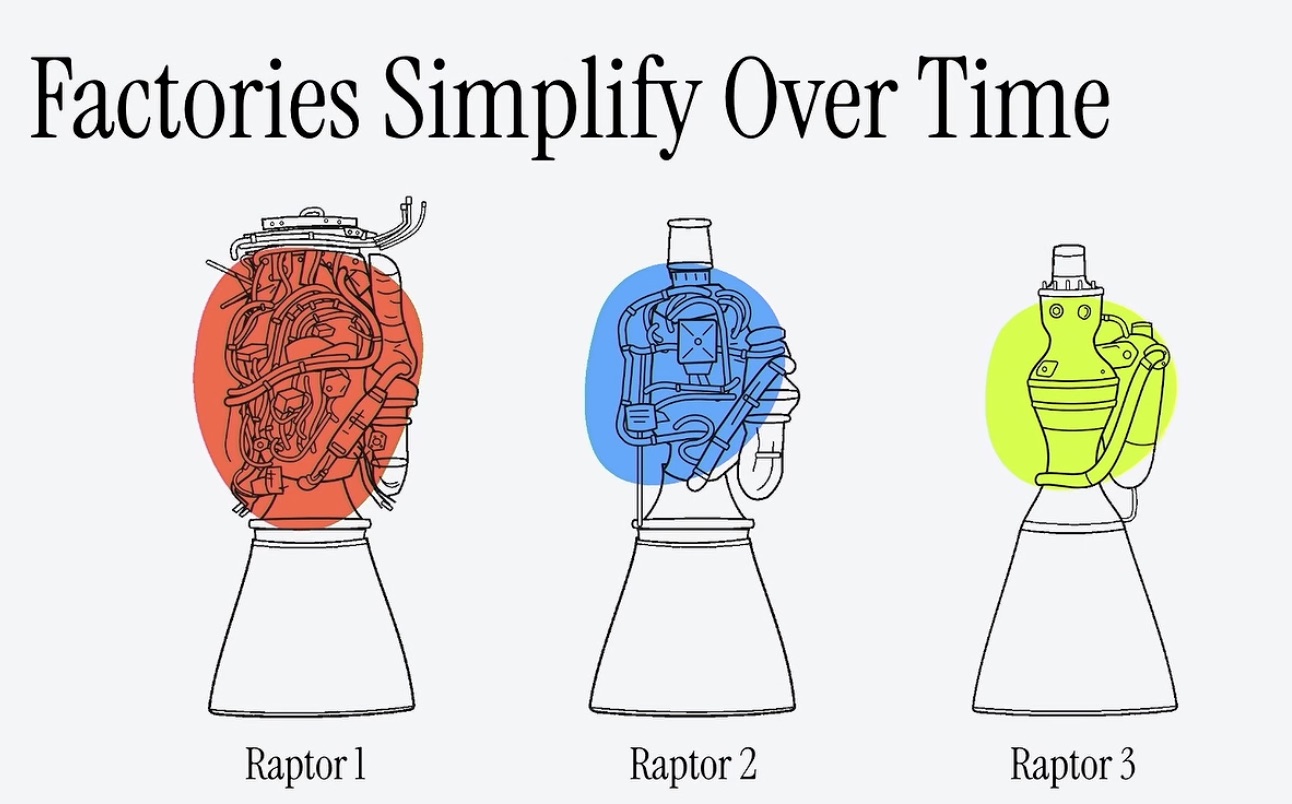
Raptor 1 was a tangle of external pipes, wires and sensors. Raptor 3 moved most of that plumbing into the engine's main structure and dropped the protective shrouds the earlier engines needed. It's also stronger: SpaceX's target for Raptor 3 is 280 tonnes of thrust at sea level, up from 185 for Raptor 1.
The method behind it is written down. In Walter Isaacson's biography, Musk's five-step "algorithm" starts with "question every requirement." Step two is "delete any part of the process you can." Automation comes last.
Most agent setups run that list backward. We automate first and never delete.
Ablate, then add back only what fails
Machine learning has a word for disciplined deletion: ablation. You remove one component and measure what changes. If nothing breaks, the part wasn't earning its place.
Do that to your harness at every model upgrade:
- Turn it all off. Disable every skill, rule, and MCP server you added for the old model.
- Run real work. Give the new model the tasks it handles every week, and compare the results.
- Add back only what still fails. Each addition needs a failing task to justify it.
- Date what you add back. Note the model it was written for. That's its expiry date.
Isaacson describes Musk's rule of thumb for this step: if you never have to add a part back, you didn't delete enough. The same holds for skills.
Guardrails stay. Guidance expires.
Ablation doesn't mean letting the agent loose. It means splitting the hairball in two.
Guidance tells the agent how: which files to read, which order to work in, which tool to prefer. Guidance is written for one model and expires with it.
Guardrails say what must not happen, and keep a record of what did: a spending limit, data it can't touch, tests that must pass, a log of every action. Guardrails don't depend on the model.
Guardrails are what make exploration safe. Every move is accounted for, so every move can be corrected. When the agent tries something new and it fails, the environment pushes back and the agent adapts. That's the situated action from my last post.
Keep the guardrails tight and the guidance thin. Let the new model show you what it can do before you tell it how.
A skill is a note to a model that no longer exists. Read it again before you hand it to the next one.